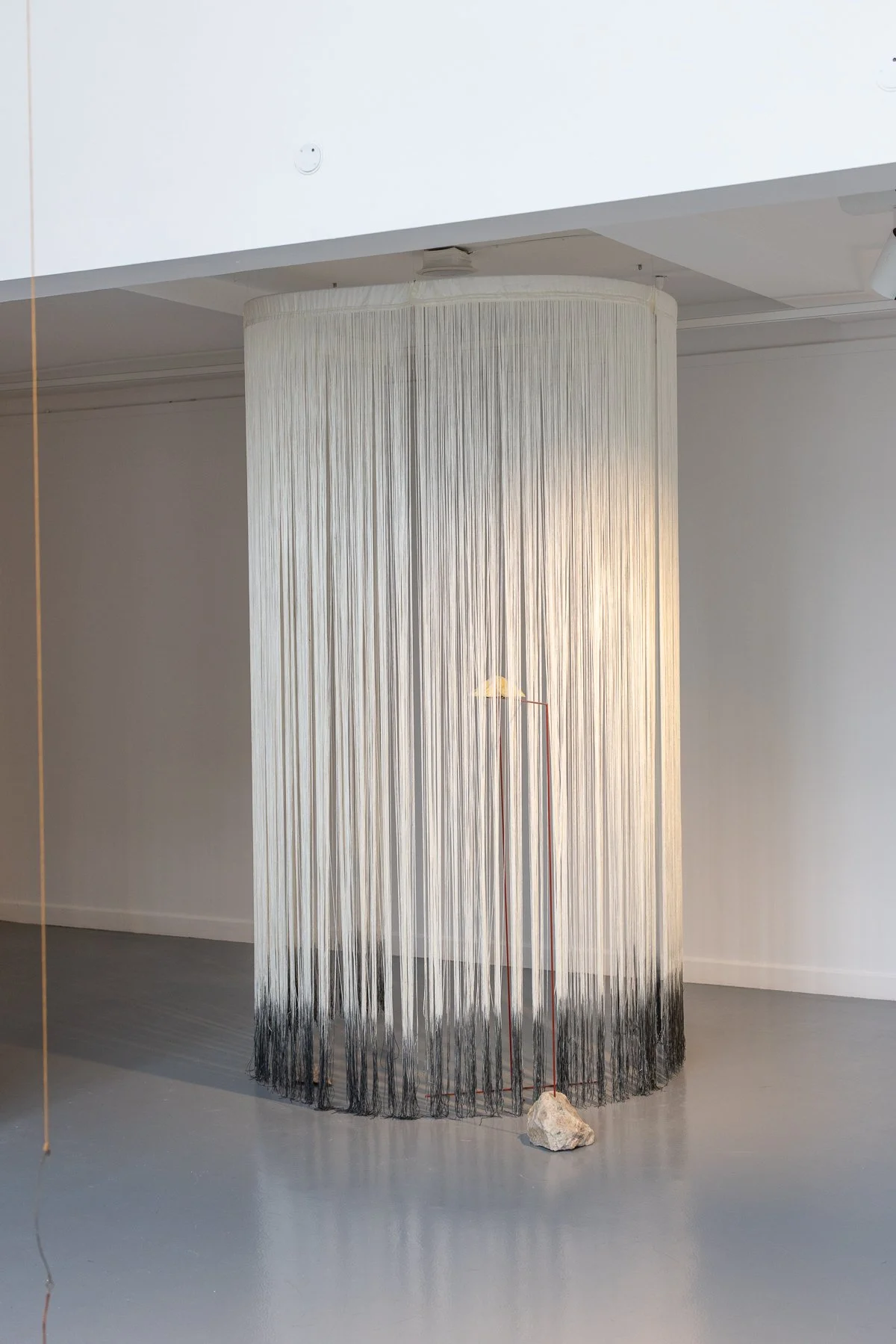
Elaine Grainger’s art is full of very specific things. They might be constructed or found, organic or inorganic, useful or useless. There can be things that help to make or support other things: threads, cables, metal frames, lumps of rock. And there are objects that seem resolved in their purpose, sure of their place in the world: a chair, a vase, a cardboard box. Some such objects might be directly meaningful — part of a story the artist wants to tell, relevant to something precise in the artist’s experience — or maybe not, instead aligning and accumulating as one enigma after another. For a complementary tendency of Grainger’s sculptures, installations, performances and more, is a commitment to combining materially definite components — real, solid things, right there in front of us — with a sense of the world as ineffable and ungraspable. Each object opens a space of uncertainty or expanded possibility around itself — like vibrations and reverberations as a drumstick hits a drum. Writing about the poet Elizabeth Bishop, Colm Tóibín wrote of how her art begins from “the idea that little is known and much is puzzling” and so the effort to “make a true statement in poetry — to claim that something is something, or does something — required a hushed, solitary concentration.” Comparing Bishop’s poetry to Dutch Golden Age painting, Tóibín draws attention to the ways that in these forms of art “something is made that is both real and filled with detail, but, in the play of light and shadow, in the placing of people and things, in the making of figures, it is also totally suggestive, without any of the suggestions being easy or obvious.” Bishop herself, writing to fellow poet Robert Lowell, suggested that “since we … float on an unknown sea … I think we should examine the other floating things that come our way very carefully; who knows what might depend on it?” Perhaps in similar ways — with a related, muted interest in an approach to art that feels, variously, from one moment to the next, both grounded and ‘afloat’ — Grainger’s contemplative piecing together and picking apart of disparate things would seem to come, as Tóibín says of Bishop, both “from what is said and what lies beneath,” using “exact detail to contain emotion, and suggest more.” — Declan Long