what can I give you ? a text by Julie Landers in response to Moving Through Things at STAC Gallery Tipperary 2025 by Elaine Grainger

What can I give you?

 When did the ache in my muscles supercede the precociousness?

What can I give you?

I have been the pilgrim,

one of the women running towards you,

the timekeeper,

the innkeeper.

 In each role I have been humbled by something greater, reduced to be rebuilt, a muscle rejecting death.

Read More

A text by Declan long in response to Moving Through Things an exhibition by Elaine Grainger at STAC Gallery Tipperary, 2025 by Elaine Grainger

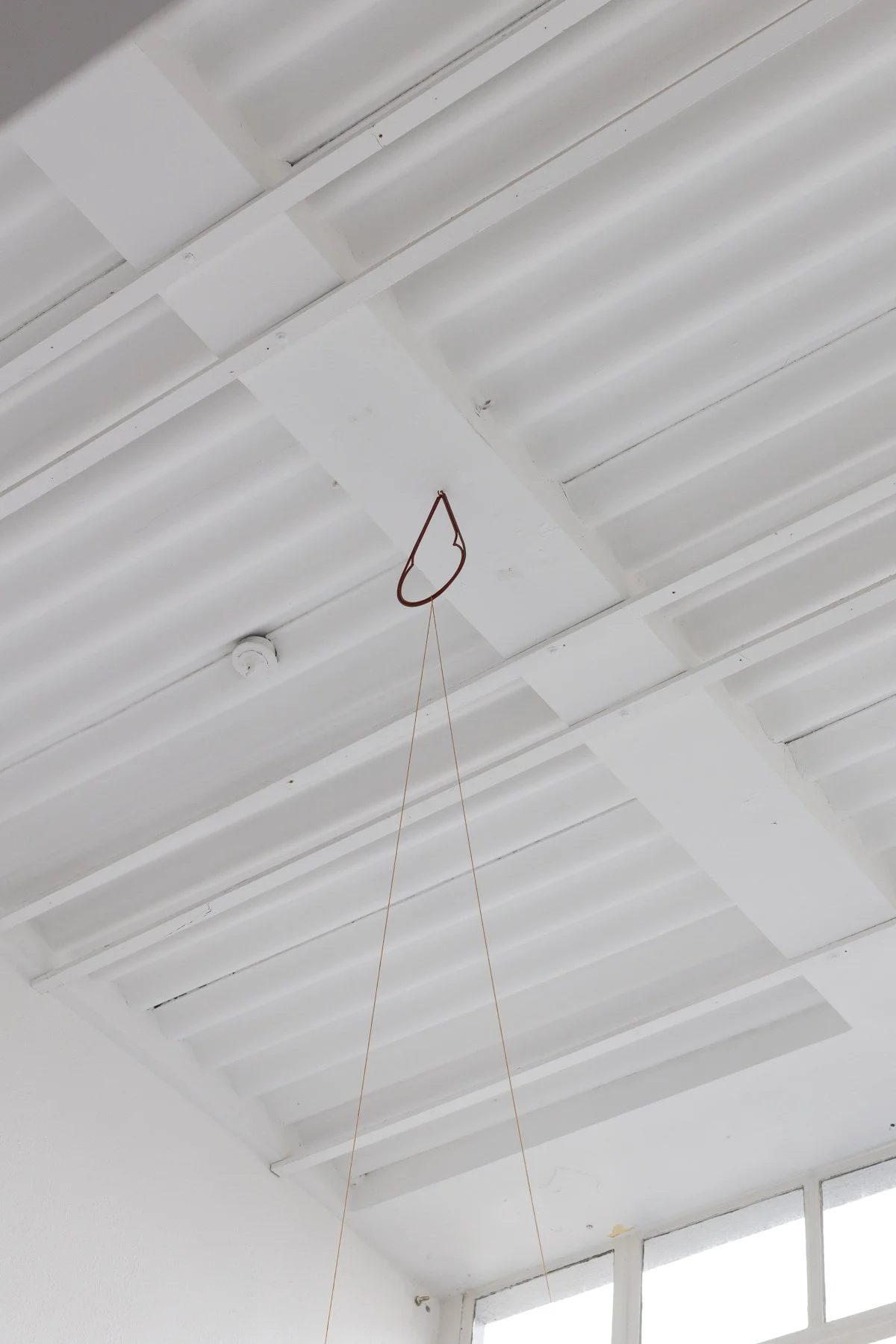
Detail view Series of Movements I, mild steel architectural object and thread Moving Through Things STAC Gallery Tipperary, 2025 Image credit Aisling McCoy

Elaine Grainger’s art is full of very specific things. They might be constructed or found, organic or inorganic, useful or useless. There can be things that help to make or support other things: threads, cables, metal frames, lumps of rock. And there are objects that seem resolved in their purpose, sure of their place in the world: a chair, a vase, a cardboard box. Some such objects might be directly meaningful — part of a story the artist wants to tell, relevant to something precise in the artist’s experience — or maybe not, instead aligning and accumulating as one enigma after another. For a complementary tendency of Grainger’s sculptures, installations, performances and more, is a commitment to combining materially definite components — real, solid things, right there in front of us — with a sense of the world as ineffable and ungraspable. Each object opens a space of uncertainty or expanded possibility around itself — like vibrations and reverberations as a drumstick hits a drum. Writing about the poet Elizabeth Bishop, Colm Tóibín wrote of how her art begins from “the idea that little is known and much is puzzling” and so the effort to “make a true statement in poetry — to claim that something is something, or does something — required a hushed, solitary concentration.” Comparing Bishop’s poetry to Dutch Golden Age painting, Tóibín draws attention to the ways that in these forms of art “something is made that is both real and filled with detail, but, in the play of light and shadow, in the placing of people and things, in the making of figures, it is also totally suggestive, without any of the suggestions being easy or obvious.” Bishop herself, writing to fellow poet Robert Lowell, suggested that “since we … float on an unknown sea … I think we should examine the other floating things that come our way very carefully; who knows what might depend on it?” Perhaps in similar ways — with a related, muted interest in an approach to art that feels, variously, from one moment to the next, both grounded and ‘afloat’ — Grainger’s contemplative piecing together and picking apart of disparate things would seem to come, as Tóibín says of Bishop, both “from what is said and what lies beneath,” using “exact detail to contain emotion, and suggest more.” — Declan Long

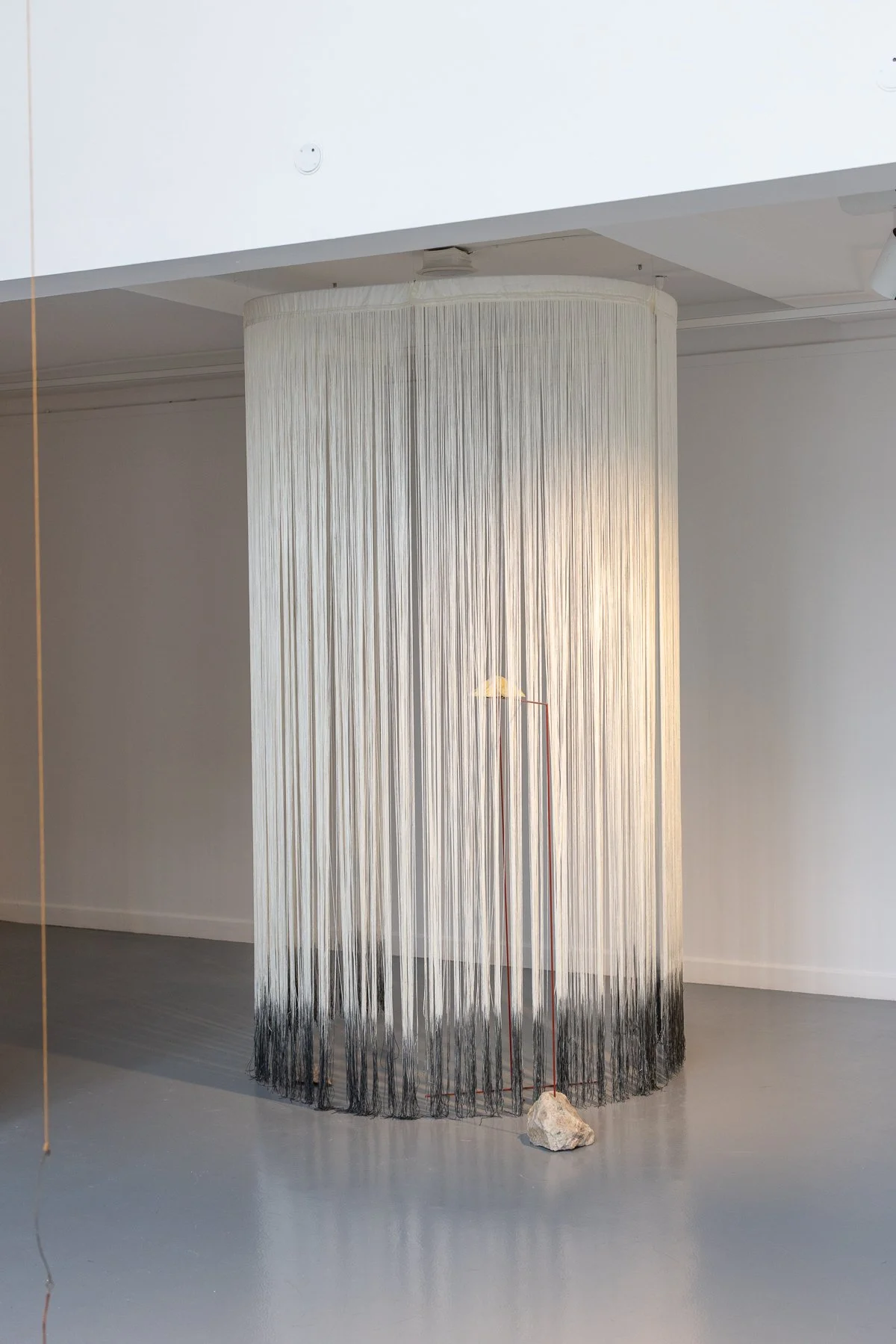
Series of Movements III, Circle mild steel with string curtains dead leaf mild steel structure with oxidised paint, cast body butter mountain, stone and sound piece ‘what can I give you” stereo sound, 2 minutes looped, 2025 Moving Through Things at STAC Gallery 2025 Photo credit Aisling McCoy

Declan Long is a critic and lecturer at the National College of Art & Design, Dublin

A Review of Echo Mapping Elaine Grainger and Moa Gustafsson Söndergaard at PINK by Laura Biddle for Corridor 8 by Elaine Grainger

There is no mistaking the fact that you’re walking into an old administrative building when you visit PINK, ‘a gallery, artist studios and event space dedicated to advancing interdisciplinary research, innovative practice and collaborative exchange’. From the corporate glass entrance and welcome desk to the thin wiry carpet and ceiling tiles, the building is every soulless stereotype of an office block that you could conjure. Then you reach the second floor and it all changes. This is the main exhibition, event, anything-you-want space and central hub of PINK. 

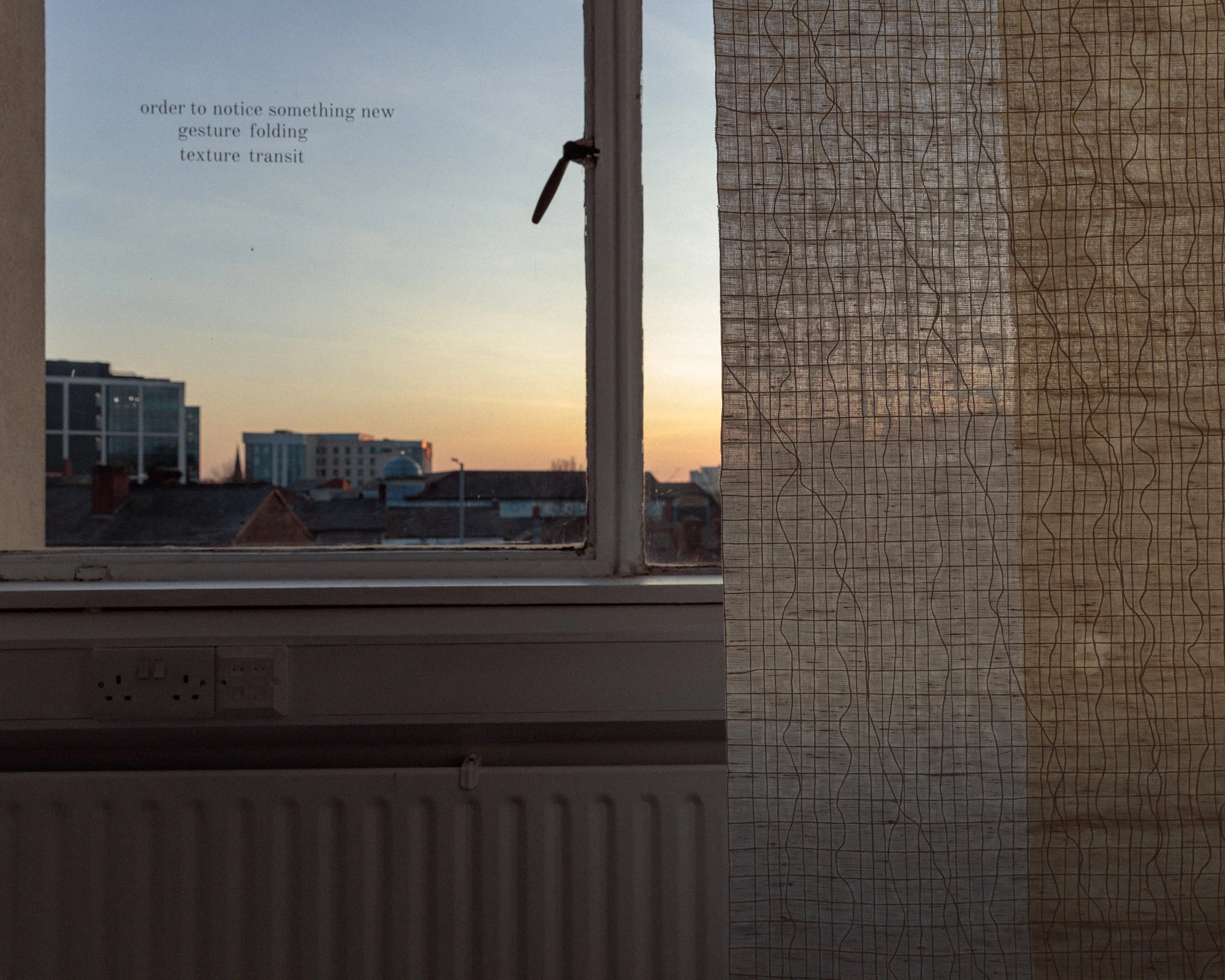
The space is bright, with two of its four main walls made up of windows. Amongst the glass and the plethora of radiators and plug sockets that powered the former workspace, there are currently delicate works by visual artists Elaine Grainger and Moa Gustafsson Söndergaard. Their exhibition Echo Mapping is the first in PINK’s new series of international residencies, inviting artists to create site responsive work reflecting on Stockport’s shifting landscape, encouraging fresh perspectives on aspects of the town often overlooked by locals living amongst it. The last few years have brought tangible change to the former industrial town, resulting from a one-billion-pound investment in it from the council to ‘attract individuals and businesses to live, work, play and connect’ by improving transport links, investing in leisure amenities, maintaining historic features and building new business areas, housing opportunities, and creative hubs. 

Grainger and Söndergaard have worked on several projects together after meeting in Reykjavik in 2023 and discovering shared interests in architecture, the impermanence of place, local materials, word mapping, movement and the ephemeral. A key mutual process is walking, and this is what they spent much of their time in Stockport doing – observing the intersection of humans and the built environment, the town’s disorientating topography and its industrial past and urban transformation. ‘You can feel its history and see its future’, notes Grainger poetically as we speak on the opening night. ‘You can see the traces and fading and bleaching which is the sort of ephemerality we’re both interested in. A place like this kind of sits in you, you feel it.’ 

To document this, Grainger and Söndergaard took thousands of photos and interrogated the place and its direction through mind and word mapping within the gallery space which served as an active research hub. They then returned to their homes – in Ireland and Sweden respectively – to work separately, maintaining contact with each other and PINK’s curator/director Katy Morrison via video calls. The week before opening they returned to Stockport to communally install the works, having decided that they would occupy different planes – Grainger the floor and Söndergaard the windows. 

Elaine Grainger and Moa Gustafsson Söndergaard, Echo Mapping, PINK 2025, installation view. Image shared courtesy of the artists.

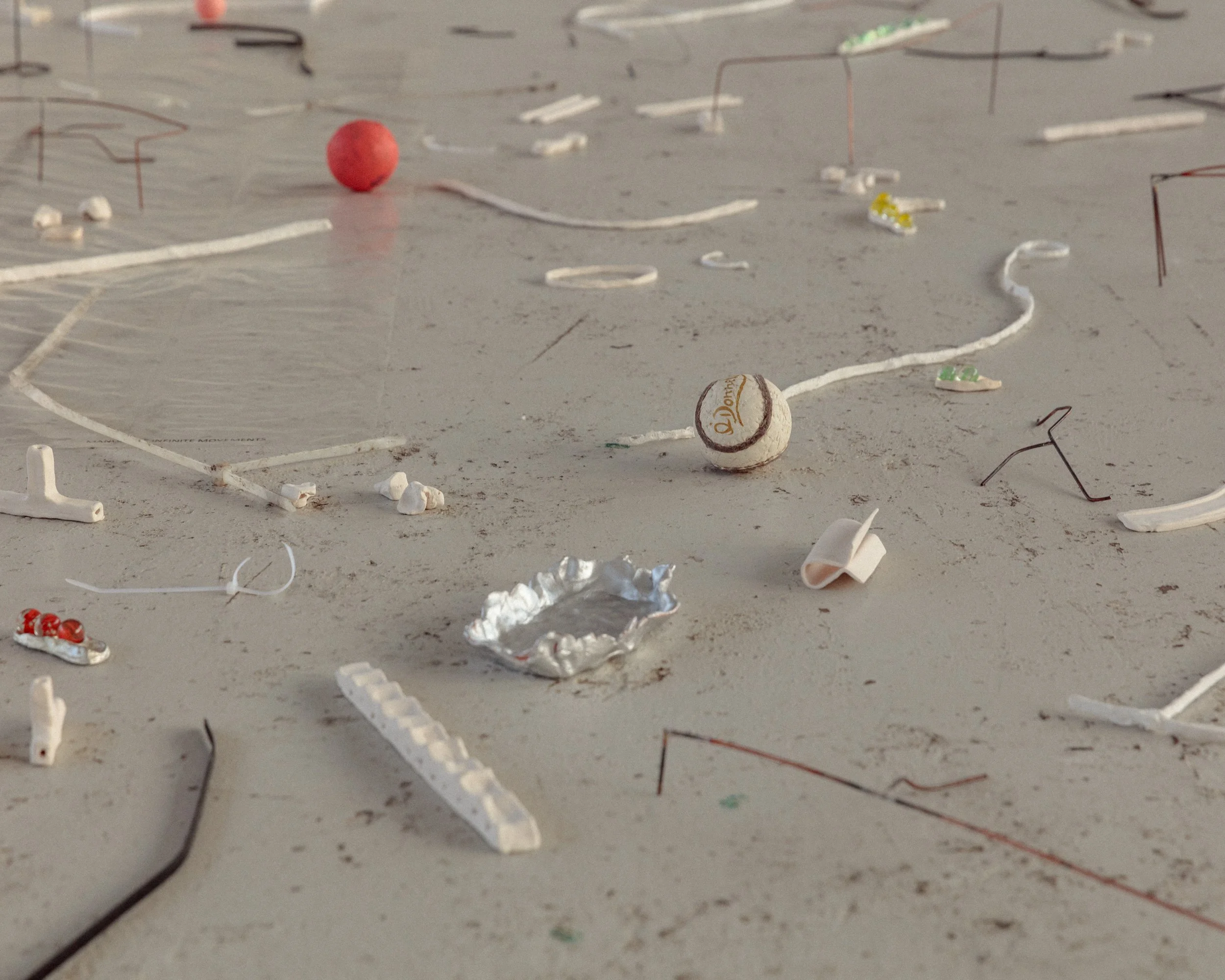
As you enter the space you see Grainger’s ‘Manual of Infinite Movements’ (2025) – small objects covering a large central area of the floor, visually similar to a cross between Sarah Sze’s (born 1969) graceful yet precarious assemblages and Tony Cragg’s (born 1949) readymade flat lays. As you crouch down to decipher what you are looking at, and discern between object and shadow as the sun dances across the window-lined space, familiarities start to come out. There are plastic cable ties and plaster casts of cable ties, marbles, wire, and loosely formed clay shapes still bearing the trace of Grainger’s hand, all laid upon and around a list of words typed and printed onto vinyl. 

In Ireland, during the pre-election period candidate posters are displayed across towns using cable ties then cut down during the aftermath. Following the 2024 Irish general election, Grainger noticed hundreds of cable ties adorning the streets where posters had hung, and she began collecting them on her walks to and from her studio – a record of her movements. To her they represented not only ephemerality – a recurring theme in her work – but also the increasing commodification of our attention, where people, brands and campaigns vie for our consideration. Not just to sell products but ideas, causes and politics. This notion of drawing and holding attention is also reflected in Grainger’s use of the floor. ‘It’s often ignored’, she states, but it is where she works in her studio. It therefore seemed a natural choice, also lending itself to what she describes as the ‘playful, performative’ act of placing and moving the components. 

Grainger was interested in Stockport’s infrastructural connections – the trains, the viaduct, the river Mersey – and the cable tie became a metaphor for this. The resistors used in train engineering are usually made of ceramics or glass which informed her use of clay and inclusion of glass marbles, while the text work which literally and figuratively underpins the piece lists her research materials and brainstormed words. The marbles link back to the notion of play and act as pops of colour to an otherwise greyscale work, as well as reminding you how beautiful these  children’s toy, commonplace throughout the early and mid-twentieth Century, are.  

Elaine Grainger and Moa Gustafsson Söndergaard, Echo Mapping, PINK 2025, installation view. Image shared courtesy of the artists.

The other work Grainger produced, ‘Score of Infinite Movements’ (2025), features three flat screen televisions laid on the floor with their wires and cables fully exposed, displaying synchronised footage cutting between images gathered in Stockport, Morocco, Dublin and Japan. The visible electronics give a fluidity to the work, embodying Grainger’s interest in presenting the process rather than the perfected, and aesthetically resemble the sort of map features that so interested the artist – contour lines, roads, railways and rivers. These universal connectors intertwine around the screens showing clips that are harder to assign to their respective country than you might expect, and the wires pull these places together into a physical embodiment of Grainger’s experiences and consciousness. 

Aesthetically, Söndergaard’s works chime so neatly with Grainger’s ‘Manual of Infinite Movements’ that you could be excused for thinking they were made by the same artist. Her ‘Blueprint’ series (2025) consists of four works of vastly differing sizes made using second-hand fabric painted with beeswax. The wax turns the fabric translucent whilst the threads laid over the surface creates a subtle pattern – the weft is structured, evenly spaced and straight, whilst the warp is meandering and wild. The resulting loose grids represent Stockport’s changing layout whilst the wandering line recalls its paths, waterways and roaming elevation. 

Applying beeswax to the fabric was a new technique for Söndergaard who is drawn to experimentation and chaos, though these works are gentle and refined. ‘In the Western world, order is seen as good and chaos as bad’, she tells me, ‘but in indigenous communities that isn’t the case’. So, instead of eschewing chaos, Söndergaard embraces it, learns from it and runs with it. She likens this to Stockport’s skyline – jarring, wonky, mismatched – and the attitude of the locals ‘adapting and embracing the change’. This dynamism is reflected in how  Söndergaard eventually installed the works. They are all hung differently – one draped and shifting in the light breeze, one tightly framed and propped on a windowsill. Another is in front of a window revealing traces of movement outside, and one is mounted on a column that blocks light to the middle of the work. They allow the building and town to affect the work even after its completion. 

This theme of working with the unusual space, rather than fighting against it, continues with Söndergaard’s other work, ‘Bird, Fish or In Between’ (2025) where lines of vinyl text have been adhered to the expansive windows that line the exhibition space, containing it yet opening it to the outside world. There are twelve stanzas positioned at different levels. Each comprises three short lines, the structure of which comes from a traditional Swedish game ‘Hide the Key’ where seekers locate the hidden key by asking the hider if it is a bird (high), a fish (low) or in between. The words themselves are poetic suggestions, partial thoughts, a fleeting sense of something not captured but offered up to be pondered over. Similarly to Grainger, Söndergaard rarely works with bold colours but wanted to introduce a subtle palette of yellow, orange and red that mimicked the sun’s rise and fall through the windows behind.  

Elaine Grainger and Moa Gustafsson Söndergaard, Echo Mapping, PINK 2025, installation view. Image shared courtesy of the artists.

The work is influenced by Söndergaard’s research into what it means to be human in a world in flux, one where we are replacing connection with the natural world with the digital one. This inability to ground oneself and take stock of your place in time and space was galvanised by Stockport’s layered architecture and undulating landscape which makes locating ground level challenging. The text’s format and placement make it difficult to see at first, conjuring that feeling of disorientation. To remedy this, you have to move closer, negotiate the light and search like you’re playing your own game as the words slowly reveal themselves as both you and they settle into the space. 

I Leap A collaborative response between Elaine Grainger and Moa Gustafsson Söndergaard to You observe I observed , Juxtapose Art Fair, Denmark 2023 by Elaine Grainger

I Leap 

Written by Moa Gustafsson Söndergaard arranged by Elaine Grainger

I see you from across the room. You are bending your body, falling into a position. Reaching, filling a gap with your fingers. Slowly stretching before the next cue. To begin again is to remove your hand from the wood. Fold your body towards the floor. Placing weight on your back. Feeling the concrete. Resting is a transition between movements. I move towards the edge, a wall. I am creating a route to communicate. You are still in between stages. Your body is glued to the beginning. To the first score. To concrete. I am mapping the alternatives. Letting my hand slowly follow the textures of the wall. I am closing my eyes, trusting my hand to guide me. You are not a passive observer. You pick yourself up, extending your body, reaching your hand towards the sky. Looking up. I am rethinking my position hitting the edge of the architectural outline. What's next? Do I dare move the structure of this space we have created? It is only wood. Looking up also means letting the gaze wander. Your body is open, open to the possibility of it being closed. Your hands are touching the particles of dust that are flying all across the room. You feel completely free as you watch me in slow motion pushing the wooden structure to the ground. Everything that was slow, repetitive, becomes a fast decay as the structure falls to the ground. You are not trying to stop me, somehow you know the rituals that dictate this space. For something to restart again it needs to have a proper ending. An end that is open, open to the possibility of it being closed. To begin again from the exact same viewpoint but with a different outcome. So. I see you from across the room. You are bending your body, falling into a position. I leap. 


I leap, falling into a position. You are bending your body. I see you from across the room. It begins again from the exact same viewpoint, but with a different outcome. There was an end, an end that was open, open to the possibility of it being closed. For something to restart again it needs to have a proper ending. You are not trying to stop me, somehow you know the rituals that dictate this space. A fast decay has happened, a structure has fallen to the ground. A repetitive movement, a loop was broken. You are feeling completely free as you see me moving in slow motion. Your hands are touching the sky, the particles shimmer in the light. An immediate touch. Your body is open, open to the possibility of it being completely closed. What's next? Do I dare to move the structure of this space we created? Looking up also means letting the gaze wander. Looking up. I am rethinking my position leaping off an invisible edge. You pick yourself up, extending your body reaching your hands towards the sky. You're not a passive observer. I am mapping the alternatives. Letting my hand slowly follow the textures of the wall. I am closing my eyes, trusting my hand to guide me. To concrete. You are still in between stages. Your body is glued to the beginning. To the first score. Resting is a transition between movements. Reaching, filling a gap with your fingers. I move towards the edge, a wall. Feeling the concrete. I am creating a road ahead, a way of communicating. To begin again is to remove your hand from the wood. Fold your body towards the floor. Placing weight on your back. I see you from across the room. Slowly stretching before the next cue. 


Pink Palace Text by Laura Ní Fhlaibhín in response to the exhibition HOLDING ON Lightly at The LAB Gallery Dublin by Elaine Grainger

The Pink Palace


The pink palace sways and floats on the corner of Foley Street.  A benevolent palace, not descended from an imperial lineage of fortresses and castles and settlements and cathedrals and towers and arrows and mines and booby traps and walls and surveillance posts and shields and statues and drones, but one of air channels and sun traps and clay pads and dancing womb-linings.

Majestic plastic billowing womb-lining twins that never got sick and tired and inflamed but rather grew more palatial and pink with each solar rotation. The lining twins never tore, the stitching held, the sheets swelled with optimum air quality conditions thanks to kind guardians that hold the door gently. The majestic, airy, smooth towering womb-lining twins, devoid of lesions and cysts, are the ideal thickness grade, measurement and form, dimensions and interiors to appreciate in an ocean of cavities and evacuations and floods. 

The pink palace blueprints were sketched in the hospital site, in a cavity where the MRI machines and the waiting room and the magnet shell enclosure had been before. The hospital-grade, plastic laundry bags had been procured in bulk, after a lengthy tendering process, to ensure infection control and the safe containment and transportation of contaminated laundry in steel trolley cages across the colour-coded hospital corridors and operating theatres and wards to the basement tunnel washers.

In a past grey time, the tunnel washers had been humans, women and girls washing and ironing and stitching laundry from all the hospitals and from all the malevolent palaces and castles and cathedrals and government buildings, their washing and bleaching and stain-removing was involuntary and coercive and cruel and violent in all of the ways we fear.  After a long time the grey slowly faded out of sight to the base layers, and the women and girls who had been imprisoned and enslaved and starved and marked and isolated for their lifetimes were replaced by a long and loud stainless steel machine known as a tunnel washer or a continuous batch washer, that vibrated all along the concrete hospital basement floor.

The hospital-grade plastic laundry bags were procured in bulk because they had been formally tested and approved by many health services and because they dissolved in water and left only harmless trace components with very little environmental impact and because they were puncture resistant. The bags were found under cement and dust and rubble in the cavity where the MRI machine had been, near to the shards from the magnet shell enclosure, and some were pierced somehow in spite of all the tests but some of the other bags buried in the pile were perfect. At first the bags were repurposed as sheets for sleeping and as tourniquets for bleeding and as barriers for resisting infection and later as windows and doors and walls for living after the most recent grey time.

The pinkness of the plastic laundry bags were noticed by a human who was utilising them to resist infection and then with time, to make walls from the wind on the site where the hospital had been before. The human was tickled by the pinkness of them around and in all of the grey everywhere that  continued to drop down from above in powdery clouds and rise up in rubble and catch in her nostrils and all the way down to her lungs. In the time of laundry bags as barriers, this human started to sketch and mark the bags, layering and folding corners and tracing all sorts of things she knew had happened. Then later she ironed them flat through her own choice and decision and through her own hands because there was no electricity to use an iron or to use any of the hospital equipment. She hoisted and wrapped and knotted the edges of the laundry bags to build transparent walls that reminded her of paintings in a cave that she had visited once while on holidays before. 

The pink plastic blueprint barrier walls were wrapped and folded and stored after the grey time dissipated slightly. The same human who was tickled by their pinkness was older now and she was  with other humans who had also utilised the laundry bags as barriers and sheets and tourniquets and windows and walls and doors, on the same hospital site and on and in other cavities all across the city and region. These bags had been folded, hand-ironed and stored as reminders and containers of flashing images that came back often, and so they had never dissolved into sinks and pipes and soil and streams and oceans. These humans who had gathered with their collections of plastic laundry bag-containers of flashing images, decided to build a pink palace together that was not a palace of slit windows to shoot arrows and throw grenades. They stitched the sheets together and they did so with such love that the stitchings have never ripped since and the punctures from the time before, when the radiology suite in the purple section of the hospital was hit with such force to cause the magnet shell enclosure to completely collapse, somehow sealed themselves together again in a miracle, with a substance resembling slug mucus glistening at the puncture wound marks.

So many pink plastic laundry bags had been gathered and stored and held tightly that the humans realised they had stitched enough to create a double-lined pink palace. Once all the edges were hoisted and pinned, as they remembered doing a long time before in the very grey times, the linings started to billow and dance around, an effect they had not anticipated and one that was very different from the taut surfaces they had sculpted back in the past grey time when they were building walls and windows and doors for living again. The double-linings, that they jokingly referred to as the twins,

allowed for hiding spaces and warm channels and they started to play in these passage ways and move the linings slightly this way and that to bring the sun inside.

The sun traps that appeared and disappeared in rhythm with the solar rotations were the ideal dimensions for lying beside and in between the pink, double womb-lining twins, and for suddenly remembering in bright flashes, the long faded marks they had made in a past time on these very sheets in the hospital site cavities and in cavities all across the region, that had reminded them of cave paintings from a now very distant holiday. They all remarked that since it was such an ideal palace to absorb the sun and light and optimum air quality conditions, they would bring their succulents and mosses, and the little clay pads they had squeezed in their hands and attached to metal lengths to hold the vulnerable plants upright, here.


Laura Ní Fhlaibhín, is an artist currently living between London and Wexford. She has been commissioned to write this text in response to an exhibition by Elaine Grainger HOLDING ON Lightly at the The LAB Gallery Dublin, 2023.

undone A Collaborative Project at Körpasstradir Gallery, Reykjavik with Moa Gustafsson Söndergaard by Elaine Grainger

undone 

During a period of five days the artists Elaine Grainger and Moa Gustafsson Söndergaard worked with the gallery space at Körpasstradir in Reykjavik. The space which was an old working barn, became the starting point of the work undone


For each day to begin with a sculptural intervention of the architectural features. For each day to choose a different path to follow. 

A project whose core is situated around temporality and how to collectively map and understand it within a space. The artists worked organically alongside each other. Starting off with rearranging and observing the change of work from previous days. Keeping a sense of playfulness yet a sincere approach to the installation, crucially being sensitive to the space not imposing themselves on it. Creating works that correspond with both the space and the artist's own sculptural voice. Using materials that are familiar to the surrounding area, also including selected materials, brought in to interact with the set environment. 

The outcome is a temporary installation where gentle gestures suggest that someone has been there mapping and reflecting upon its existence. 

This collaboration has been initiated during the beginning of an international residency at SIM Reykjavik, Iceland,  March 2022. An immediate connection was made between the artists Elaine Grainger (IE) and Moa Gustafsson Söndergaard (SE) on a personal level and also through informal discussions relating to commonalities in their practices. The artists proposed a collaborative site-specific intervention in the space linked to the residency site. 


The Limits of my Language Text By Michaela Nash by Elaine Grainger

Nothing is ever fully present in signs.
It is an illusion to believe I can ever be fully present to you
in what I say or write, because to use signs at all entails all my meaning being somehow always dispersed, divided and never quite at one with itself.(1)

The word Being cannot be contained by, is always prior to, in fact transcends, signification. Being. Being. Since the word is inadequate it is crossed out, since it is necessary it remains legible, under erasure.
Language is incomplete and unstable.(2)

Not only my meaning. Indeed but I myself: since language is something I am made up of, rather than simply a necessary tool I use, the whole idea that I am a stable unified entity must also be a fiction.(1)

I don't think my first language can be written down at all. I'm not sure it can be made external you see. I think it has to stay where it is; simmering in the elastic gloom betwixt my flickering organs.(3)

I'm not sure it can be made external you see. I don't think my first language can be written down at all. Simmering in the elastic gloom betwixt my flickering organs. I think it has to stay where it is;(3)

It can be made external I'm not sure. In the elastic gloom simmering. My first language can be written down at all I don't think. My flickering organs betwixt, where it is, it has to stay, I think;(3)

It can be made external, in the elastic gloom simmering, first language can be written down. flickering organs betwixt, where it is, it has to stay;(3)

be made external, in the elastic gloom simmer, can be write down. flick organs be to stay;(3)

be made in the can be write down, be to stay;(3)

bi meɪd ɪn ðə kən bi raɪt daʊnbɪ tə steɪ(3)
bi meɪd bi raɪt daʊn3

bɪ3

In the space,
the air is setting
on your skin, cool
and flushing over your brow
to the bridge of your nose, it rests on your lips, like the disturbance of air after a word spoken

As you move past white walls, over sandstone tiles, the air ripples between you and the artworks,
the contact of your feet, shivers through porcelain dust, scattering molecules into the air as scent;

chalk,

plastic,

fresh wood,

cut stone,

acoustic dusts,
reverberating between white walls
suspended by the dialogue of one video
calling to another on each side of the space,
their voices ripple into the sculptures
which collect every murmur into the quiet weight of their bodies
becoming the pauses between words, the meaning passed over in silence

Air silently percolates through the metal lines and granite syntaxes of the sculptures
drifting between the holes and gaps of language

Of what must be said and
what can be felt but never heard

Air trembling from

disturbed vibrations, condense into a pressure felt

quivering over skin, alerting hairs on the back of necks, to the swelling volume of molecules;
rising into a cloud forming;
over a pale blue sky-

A hand
wading through the
weight of air into motion
beckons the body and air it passes through into speech

Fingers take the shape of the sign between meaning and utterance the rising pitch of the theremin; a mouth opened and speaking

Particles quake,
interference of air builds into,
the theremin’s whine signalling rain
ringing inside of pulse, cymbals shatter over wrists
clouds gather their weight with water, rippling between shoulders,
drums resound into chests, thunder rolls through throats
the flash of high hats, scattering over cheeks, into arching cerebral static words collapse into sensation, clouds condense into rain, falling over your skin as dark marks over dry stone. A sensory data, which dries into the plumes of white lichen on your body. Light from the projector submerges your hands with floating speckles of kin crying warnings through their flesh

Our own bodies no longer awake to the unseasonal heat of air, the strange heights of river water, the prick of a storm arriving on your neck
Or the first burn of a drop falling;

Cognitive dissonance Announced to the body

Your flesh the mediator between fact and stone

C

Porcelain dust,
Settles and falls onto

A translucent barographic line Gathering atmospheric vibrations to tape

Particles no longer suspended Drift onto granite altars

Resting
drawing tenuousness
into prayer murmured beneath breath so that words might fade into silence

Corporeal forms translate to the spaces they inhabit each new site excavating another pause
in their cyclical transformation

Porcelain dust
ground by hands
that molded clay
bound from sediment
communed from a quarry’s arch to the land.

Layers of time unravelled from fragments
magma cooled to granite, bone crushed by centuries into limestone, life fossilized into oil stretched into thin films of plastic
that collect air and porcelain dust
between sunlight

The time buried in their forms panned
into presence to reveal the value of transience
Blossoms are only blossom until they fall to the ground as apples, tentatively red and smooth, defined by what they'll no longer be once changed.
Beside them, their porcelain others, absorb moments noticed before decay. Material creating a point through which to find refuge in the
ultimate impermanence of everything
a space to empty out thoughts
absences filled with the body,

for memories to surface the edge of waiting

E

Silver furrows, crinkling into the ridges of limestone, Crushed, collapsing, compressing into hillsides, Smooth and half-remembered into a home;
Sharp, clean air; suspending the prick of new grass and hawthorn buds, late this year and awakening

the scent of earth and dust, buoyant and floating, into the grind and crush of machinery, blending into a background hum of comfort

Turquoise swelling into green, folding into orange, familiar pinks, warming into the dappled reds of light seen behind closed eyes
glimpses of memories, teased into images pieced together from a feeling

Inked blues pulse into the gold of sunlight over headlands,
the churn and clatter of morning, the land recollecting its shape,

Shapes become forms, edges fold into places, rustles become sounds

Remembered, collecting in the pit of stomachs, churning in guts, welling inside chests, through throats, along vocal chords,
Vibrating with air, swelling through cheeks
Expanding onto the tip of tongues

pressing against teeth

Pushing air
Into
The

Shape

Of

Words

Which fall with the weight Of their failure
To the ground

References;
1 Terry Eagleton, ‘Literary Theory: An Introduction’, 1983

2 Madan Sarup, ‘An Introductory Guide to Post-Structuralism And Post-Modernism’, 2nd Edition, 1993

3Claire-Louise Bennett, ‘Pond’, 2015

The Limits of my Language Exhibition Curated by Rachel Botha, with Artists Chloe Brenan, Johanna Nulty and Elaine Grainger Kilkenny Arts Office 2021
The gap between noise, 2019 Text by Ingrid Lyons by Elaine Grainger

The Gap Between Noise  An Exhibition by Elaine Grainger


Elaine Grainger facilitates encounters between materials resulting in a series of sculptures in context. They are intuitively made to emphasise attributes of found and gathered objects. 


By maneuvering and responding to the space of The Complex, a former fruit packing facility in Smithfield, she acknowledges its history, celebrating the marks and remnants of its previous uses and intervening briefly before the space morphs and its subtle interior architectures are obliterated permanently. She creates relics through reassertion, bestowing value on objects that might otherwise be cast away. In her renewed attention and appreciation, she celebrates abandoned and neglected facets of the space, transforming it into a shrine for its artifacts. In this way, her inclination towards these objects manifests in their metamorphosing into new objects with a new set of meanings. 


The Gap Between Noisecomprises atmospheric installations that conjure the factory workplace at night, unpeopled and static.The manipulation and arrangement of objects within the space form quiet and unobtrusive meditations - gestures that initiate a conversation between the materials and their environment. Each piece becomes part of a series of minor adjustments to archive the slippage between function and form, between what has defined this space and what will define it in time. Here, Grainger has intervened and paused for a moment, focusing on what exists between the layers of palimpsest, before one layer supersedes another. 


Indeed, layering and shrouding materials are part of the visual trope that recurs throughout these assemblages and allows for myriad iterations of an otherwise familiar object. And as the they are cast into semi-darkness and illuminated from hidden sources, they take on a twilight, ‘witching hour’ feel.


A polystyrene fruit tray has been cast in brittle porcelain and laid out on the rough concrete floor to create a tabular effect, we can observe the grooves and curves that represent the protection of fruit in transit. Therein lies the memory of its previous function, valorised through its reiteration in clay. Minute details of the interior have been coaxed out of hiding and embellished with thread. Patches in the chipped plaster of the wall have been isolated and framed, intimating the appearance of a fresco and allowing us to consider how such indents were left.


Since the nearby Victorian fruit and vegetable market on Mary’s Lane closed in August, it has become apparent that the days of the inner city wholesalers are numbered and that such spaces are dwindling from the city center altogether – soon to be a thing of the past. Liminal zones such as this are worth ruminating over. The marks, stains, knocks, holes and detritus strewn about the place are granted a role to play in the reconstruction of this space as a buffer zone between the old and the new. Between knowledge and anticipation. 


These kinds of spaces rarely get to exist for long - they are themselves, ephemeral. Seldom set aside for use as art spaces, such disused factories, yards and depots tend toward dereliction and eventual demolition. In a city that is changing drastically with little thought for those who populate it, there is less inclination to incorporate existing architectures and more often than not, buildings are leveled to allow for a new purpose built, and therefore homogenous kind of architecture. This in turn obliterates any potential for the social fabric of the city to live on in fragments. Traces of fading narratives are relegated to obscurity before we can assess their significance. 


With plans to join Smithfield and Caple Street, Dublin’s fruit market may soon give way to redevelopment and gentrification. In the interim, the potential for digression is abundant. Much like the abandoned spaces at the edge of the city, there are few expectations for these spaces in their current state and so the capacity for playful digression is heightened. Liverpudlian writer Paul Farley touches on this in many of his works. Taking disused buildings and edgelands as his subject matter, he considers our connection to places and the objects that populate them. 


In his poem Phone Books in which an abandoned space and its moldering contents become the subject of a meditation on the passing of time, he considers the anachronistic potential of a pile of old telephone directories,

You find them in the dark of meter cupboards 

In Kitchen drawers 


Part of the scenery left over from the last lot

Like the sliver of soap on the enamel 

The flowery curtains 

They belong there in the receding spaces


The receding spaces and fading objects Farley visualises belong to a world of ten or twenty years ago, too recent to be valued, culturally or sentimentally and yet they act as mementos of the recent past. In his poems, detritus is ruminated upon in an attempt to grasp how changes in the world around us, render objects once commonplace and abundant, completely obsolete and therefore abandoned, 


Older editions, the ones that wandered up into lofts

Or down to sheds they share with mildew 

And a Lucozade bottle of weed killer 

The codes all changed, the numbers decaying by the minute


Throughout The Gap Between Noise, Grainger takes on the role of cultural archivist. She responds to the history and architecture of the space through her work and in doing so she creates a snapshot of the space in its interim state. After it has been a fruit packing facility, during its time as an art space and before it perhaps becomes an apart-hotel, student accommodation or some other depressing manifestation of the spoils of inner city capitalism. She bestows upon the space, a celebration of its flux. Her acknowledgement of this flux invites us to reflect on the interior architecture of The Complex, how it has been marked from what has gone before and has borne witness to activities that will no longer take place there. 


Guiding us towards previously hidden narratives - whether out of sight, in the periphery of our vision or in plain sight, The Gap Between Noisemeditates on the passing of time and on the untold stories of our city’s history. In this quiet lull we can pause for a moment to ponder the rapid transformation of the area, before the fruit market, and the buildings and objects within are closed off from us again indefinitely or perhaps, permanently. 


- Ingrid Lyons


Ingrid Lyons is a writer, currently living and working in London

Moments arranged 6, Installation view, Cast porcelain, 25 roll- outs, resin, chalk dust, cast concrete, plaster, roll of structural card with floral print, concrete polo, florescent light.